



Oct 16, 2026
Kidney Disease Treatment: What Changes at Each Stage of CKD?
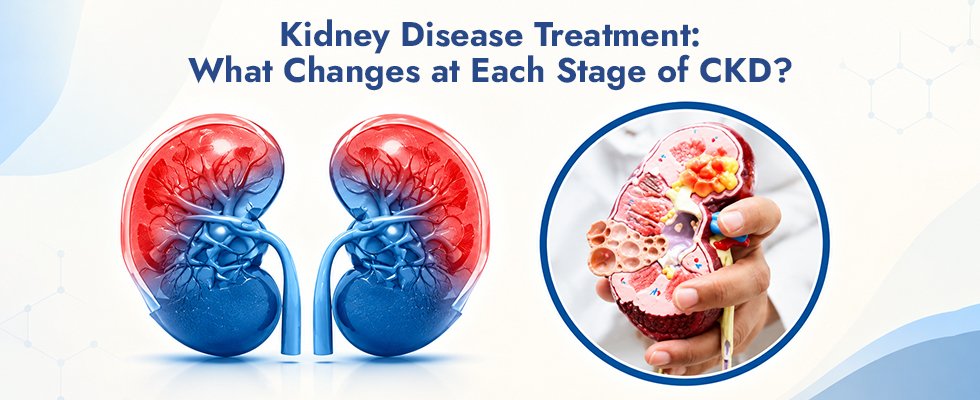
Kidney Disease Treatment - What Actually Changes at Each Stage of CKD?
Chronic kidney disease is a condition where the kidneys gradually lose their ability to filter waste, balance fluids, and regulate key minerals in the body. What makes it particularly challenging is how quietly it tends to develop - most people have no obvious symptoms in the early stages, and by the time something feels wrong, the condition has often been progressing for a while. Kidney disease treatment depends heavily on which stage the disease has reached, what is causing it, and what the individual's test results and overall health picture look like. The goal across all stages is broadly the same - manage the underlying cause, slow down how fast the kidneys decline, and prevent complications from building up. What that looks like in practice, though, changes significantly from one stage to the next.What are the Five Stages of Chronic Kidney Disease?
The staging system for CKD is built around eGFR - estimated glomerular filtration rate - a measure that tells clinicians how much filtering capacity the kidneys still have. Alongside eGFR, urine albumin levels and other clinical findings help healthcare professionals build a complete picture of kidney health and plan the most appropriate care.The stage system exists to guide clinical decision-making - not to create alarm. Not everyone progresses through every stage, and two people at the same eGFR level can have very different treatment needs depending on their underlying condition, other health factors, and test results over time.
Stage 1 - Kidney Damage With Normal or High eGFR
At Stage 1, the eGFR reading sits at 90 or higher - the kidneys are still filtering at a level considered normal. So what puts someone in Stage 1 at all? Because damage markers are already showing up. Protein turning up in the urine when it should not be there. Structural changes spotted on imaging. Blood results that are not quite right even though filtration numbers look fine. The kidneys are doing their job for now, but something is already working against them.Getting on top of that something - blood pressure, blood sugar, or whatever is behind it - is what Stage 1 management is about. Monitoring at sensible intervals makes sure things are not quietly shifting. The whole idea is to act before any real loss of function begins.
Stage 2 - Mild Loss of Kidney Function
Stage 2 puts eGFR between 60 and 89. The kidneys have slipped slightly below normal range but are still managing most of what they need to. The main question at this stage is why - and making sure whatever is causing the damage is being properly addressed.Diet, physical activity, weight, and steering clear of medications that put unnecessary strain on the kidneys all become more relevant here. Regular blood and urine tests at sensible intervals show whether things are holding steady or quietly drifting in the wrong direction.
Stage 3 - Moderate Loss of Kidney Function
Stage 3 is where CKD management starts getting more involved. It breaks into two - Stage 3a runs from eGFR 45 to 59, Stage 3b from 30 to 44 - and the gap between them matters. Risk of complications tends to climb as eGFR moves toward the lower end.Monitoring broadens out at this point. Anaemia becomes a real possibility as the kidneys make less of the hormone that drives red blood cell production. Phosphorus and calcium become harder to keep in balance. Electrolytes need watching. Blood pressure control becomes even more important than it already was. Reviews happen more frequently and blood work covers more ground each time.
Stage 4 - Severe Loss of Kidney Function
Stage 4 means eGFR has dropped to somewhere between 15 and 29. Specialist kidney care is non-negotiable at this point - the kidneys are seriously compromised and complications are a real risk.The shift that matters most at Stage 4 is thinking ahead. If decline continues, kidney replacement therapy may eventually be on the table. That conversation does not happen in a rush. It takes time - to understand the options, weigh what fits the individual's life, and prepare well before things reach a crisis point. Not every Stage 4 patient ends up needing replacement therapy, but being ready for that possibility is far better than being caught off guard by it.
Stage 5 - Kidney Failure
Below an eGFR of 15, the kidneys have run out of capacity. Waste builds up, fluids go unbalanced, minerals the body depends on stop being regulated properly. This is Stage 5 - and what comes next looks different for every person who reaches it.Haemodialysis or peritoneal dialysis can take over the filtering work the kidneys can no longer manage. A kidney transplant, for those who are medically suited to it, removes the need for ongoing dialysis sessions. Some people - particularly those who are older or carrying other serious health conditions - find that neither of those routes makes sense for their situation, and instead choose support that focuses on how the person feels and what their daily life looks like rather than aggressive intervention. That is a legitimate path too. What matters most at Stage 5 is that the decision gets made with enough time, honest information, and the patient at the centre of it.
How Does Kidney Disease Treatment Change From One Stage to Another?
The factors that shape kidney disease treatment decisions are not fixed - they shift as the condition evolves. Several things influence what gets recommended at each point:The underlying cause - whether it is diabetes, high blood pressure, autoimmune disease, or another condition - drives much of the management approach, particularly in the earlier stages.
eGFR and urine albumin results - looked at together, these two give a much clearer picture than eGFR on its own. Two patients sitting at the same eGFR but with very different albumin readings can need quite different approaches.
Blood pressure and blood glucose control - both stay central to kidney care across every stage. Uncontrolled hypertension and poorly managed diabetes are two of the biggest reasons kidney function declines over time.
Medication safety and dose adjustments - this becomes increasingly important as kidney function drops. A lot of medications are processed through the kidneys, and something that was perfectly safe at Stage 2 may need to be reviewed by the time Stage 4 is reached.
Complication management - anaemia, bone disease, fluid retention, electrolyte imbalances - these build up as CKD advances and add layers to what the care plan needs to cover.
Specialist involvement and kidney replacement planning - from Stage 4 onward, both of these become part of the conversation rather than something to think about later.
What is worth understanding is that CKD staging is a tool to guide care - not a fixed trajectory. Not every patient progresses through all five stages, and treatment decisions are always based on the full clinical picture, not eGFR alone.
Lifestyle Changes That Support Kidney Health
Follow a Kidney-Friendly Diet
Diet plays a direct role in how hard the kidneys have to work. Reducing sodium intake is relevant across most stages of CKD. Protein, potassium, and phosphorus recommendations are more individual - they depend on kidney function levels and what laboratory results are showing at each review. A diet that suits someone at Stage 2 may need adjusting by Stage 4. Specific dietary guidance should always be based on current test results rather than a generic kidney diet applied to everyone.Manage Blood Pressure and Blood Sugar
High blood pressure and poorly controlled diabetes are the two most common drivers of kidney damage - and managing both well is one of the most impactful things a person with CKD can do. Blood pressure targets in CKD are generally tighter than standard recommendations, and blood sugar control reduces the risk of further kidney damage in people with diabetes. Both require consistent monitoring and, in most cases, medication alongside lifestyle changes.Stay Active and Avoid Kidney-Harming Medicines
Appropriate physical activity supports cardiovascular health and overall wellbeing in people with CKD. What counts as appropriate varies by individual and stage - a healthcare professional can advise on what level of activity is suitable. On the medication side, common over-the-counter pain relievers like NSAIDs can be harmful to the kidneys and should generally be avoided or used only under medical guidance in people with CKD. Any new medication - prescribed or otherwise - is worth discussing with the treating clinician before starting.Which Tests Help Determine the Right Kidney Disease Treatment?
Understanding where kidney function stands requires a specific set of tests, and the results of each one contribute to the treatment picture differently:eGFR blood test - calculated from creatinine levels in the blood, this is the primary measure of kidney filtering capacity and the basis for CKD staging.
Urine albumin-to-creatinine ratio (uACR) - measures how much protein is leaking into the urine. Higher levels indicate more significant kidney damage and are associated with faster progression.
Blood pressure measurement - taken at every appointment because BP directly affects kidney disease progression.
Electrolyte and other blood tests - potassium, bicarbonate, phosphorus, calcium, haemoglobin, and other markers that change as CKD advances and need monitoring to prevent complications.
Additional investigations - ultrasound, kidney biopsy, or other tests may be recommended depending on what the treating clinician needs to understand about the underlying cause or extent of damage.
For a detailed overview of how chronic kidney disease diagnosis works - including what each test is looking for and when it is used - our dedicated blog covers this in more depth.
When Should You Consult a Kidney Care Specialist?
Kidney blood or urine tests that keep coming back abnormal - even when nothing feels wrong - are reason enough to get a proper assessment. CKD has a way of developing without announcing itself, which is why anyone carrying risk factors like diabetes, high blood pressure, or a family history of kidney problems should be getting tested regularly rather than waiting for symptoms to show up.When something starts to feel off, signs often include swelling in the legs or around the face, changes in how often or how much urine you pass, tiredness that sticks around despite rest, or unexplained breathlessness. These are worth getting checked without delay - not something to monitor at home for a few more weeks.
Chest pain, sudden severe breathlessness, significant confusion, or a sharp drop in urine output are a different category altogether - these need urgent attention, not a routine appointment booked for next week.
A kidney specialist in Jaipur can go through current test results, work out what stage the condition has reached and what may be driving it, and put together a clear picture of what the right next steps look like for that individual.
Explore Kidney Care Options at Sevyam
Sevyam HIIMS provides kidney-related care that focuses on dietary guidance, lifestyle management, and selected holistic therapies as part of an individualised approach to supporting kidney health. If you have existing kidney function test results and are looking to understand your options, our team can review them with you and discuss what supportive care may be appropriate for your situation.For patients interested in learning more about our approach to kidney care, visit our kidney disease treatment page for detailed information on the GRAD Kidney Care programme and what it involves.
Treatment decisions for CKD should always be made in consultation with a qualified healthcare professional, based on current test results and the full clinical picture.
Conclusion
Kidney disease treatment does not follow the same path for every patient. Stage 1 management and Stage 4 management look nothing like each other - and even two people sitting at the same stage and the same eGFR number can need quite different things depending on what is behind their condition, what their test results show over time, and what else is going on with their health.What holds true across every stage is simpler: finding it early leaves more options open. Checking in regularly means problems get caught before they compound. And a care plan built around the actual person - their results, their condition, their life - gives the kidneys the best possible chance of holding on to what function they still have. If kidney health is something you have been putting off looking into, or if test results have come back that you are not sure what to do with, getting a proper assessment done is the place to start.
FAQs
Can kidney disease be treated in its early stages?Yes - and early stages are actually when treatment tends to have the most impact. At Stages 1 and 2, the focus is on identifying and managing the underlying cause, controlling blood pressure and blood sugar, and making lifestyle changes that slow progression. The kidneys still have significant function at this point, which gives more room to work with than later stages allow. Understanding how to cure kidney disease - or, more accurately, how to manage and slow it - starts with catching it early.
Does every patient with Stage 3 CKD need dialysis?
No. Stage 3 CKD does not mean dialysis is imminent or inevitable. Many people with Stage 3 CKD manage the condition for years without progressing to kidney failure, particularly with good blood pressure control, dietary management, and regular monitoring. Dialysis is typically only considered when kidney function has declined to Stage 5 levels - and even then, it is one of several options discussed with the patient.
Can kidney function improve with treatment?
In some cases, particularly where kidney damage has an acute or reversible cause, function can improve with appropriate treatment. For chronic kidney disease, the more realistic goal is usually slowing the rate of decline rather than reversing existing damage. Some patients do see stabilisation of their eGFR with good management, which is a meaningful outcome even if the number does not go up.
How often should kidney function be monitored?
This depends on the stage of CKD and what the clinical picture looks like. At Stage 1 and 2, annual or twice-yearly testing may be appropriate for stable patients. At Stage 3, more frequent monitoring - every three to six months - is usually recommended. At Stage 4, quarterly or more frequent assessment is typically needed. Anyone whose condition is changing or whose results are not stable may need more frequent testing regardless of stage.




Specialist
 Lifestyle Modification
 Diet Care
 Chelation
 Panchkarma
 EECP
EECP SEVYAM at Home
 Diabetes
 Blood Pressure
 Sevyam Total Heart
 GRAD – Kidney Cure